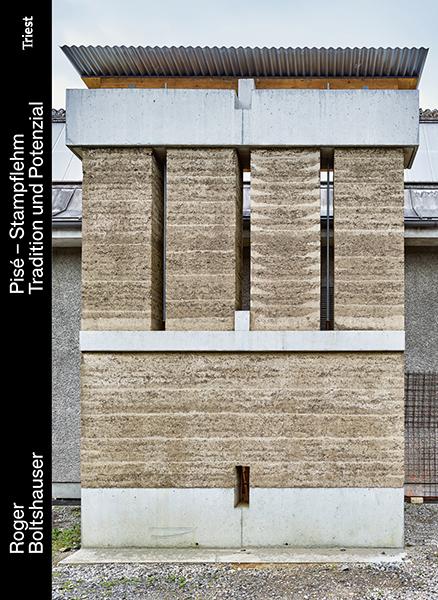
Roger Boltshauser with Mirjam Kupferschmid, Janina Flückiger, Marlène Witry (eds.)
Pisé – Hybridkonstruktionen
Tradition und Potenzial
Book design: Maike Hamacher, Zurich
German edition
480 pages, ca. 630 images, 22 × 30 cm, half-cloth hardcover
Euro [D] 98.–, Euro [A] 100.70
Available
ISBN
978-3-03863-095-1


• Strategies for a cultural change in the construction
sector by example of hybrid constructions made from natural, renewable
raw materials
• Resource-efficient construction methods and their implementation in the construction industry
• Examples from Morocco, Switzerland, England and Europe
• Resource-efficient construction methods and their implementation in the construction industry
• Examples from Morocco, Switzerland, England and Europe
Based on an analysis of historical structures in Morocco, Southern and Central Europe, the book provides the knowledge required for current applications of hybrid earth construction – not only in terms of structure but also with regard to maintaining a comfortable indoor climate.
Projects conducted by students at EPFL Lausanne, TU Munich and ETH Zurich demonstrate what this can look like. In addition to this, structures such as the kiln tower in Cham, built with prestressed rammed earth, or the Hortus project in Basel – a timber building with a hybrid earth/timber ceiling structure – show how projects of this kind can be successfully put into practice. Research buildings by Florian Nagler in Bad Aibling and Munich show how low-tech hybrid structures can be used to realise modern architecture.The focus is on the following questions:
– How can new materials and constructions be integrated into the urban fabric or specific locality?
– Can renewable raw materials be used to drastically reduce the amount of resources used?
– Can prefabrication cut construction costs so as to make alternative construction methods competitive on the market?
– Load-bearing structure, retrofitting the construction to absorb tensile forces.
– Low-tech instead of elaborate technical building services not only reduces the consumption of raw materials but also energy.
– Regulation of the indoor climate by means of passive measures instead of energy-intensive technical building services.
– Maintenance and dismantling
With contributions by:
Roger Boltshauser, Mirjam Kupferschmid, Jesús Vassallo, Salima Naji,
Jasmin Kunst, Marlène Witry, Hubert Guillaud, Camilla Mileto, Fernando
Vergas, Thierry Joffroy, Julien Nourdin, Arnaud Misse, Martin Pointet,
Isabelle Brunier, Ernest Menolfi,
Janina Flückiger, Felix Hilgert, Summer Islam, Paloma Gormley, Arno
Schlüter, Andrea Wiegelmann, Romain Anger, Laetitia Fontaine, Ryszard
Gorajek, Gregory Bianchi, Gian Salis, Rodrigo Fernandez, Laurent de
Wurstemberger, Coralie
Brumaud, Yi Du, Daria Ardant, Guillaume Habert, Jürg Conzett, Jörg
Habenberger, Tobias Huber, Katja Fiebrandt, Michael Klippel, Tobias
Bonwetsch, Götz Hilber, Oliver Kirschbaum, Florian Nagler, Jacqueline
Pauli, Tobias Fiedler, Stefan Marbach,
Marco Waldhauser, François Cointeraux
Photography: Philipp Heckhausen, Zurich
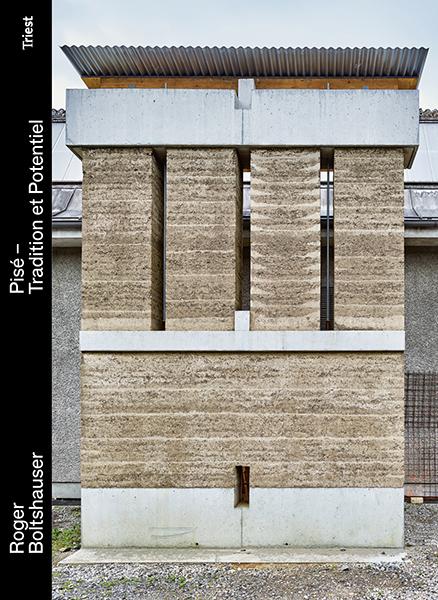
Photography Cover: Kuster Frey, ZurichAbout the editors
Roger Boltshauser, graduate architect ETH BSA SIA. Founded Boltshauser Architects in Zurich in 1996. In addition to his work at the firm, Roger Boltshauser was involved in teaching at ETH Zurich and EPF Lausanne, HTW Chur and the Chur Institute of Architecture CIA between 1996 and 2009. He was a visiting professor at EPFL Lausanne and TU Munich, as well as a guest lecturer at ETH Zurich, where he has been a full professor of architecture and regenerative materials since 2024. In the same year, he was awarded the Semper Prize.
Mirjam Kupferschmid studied architecture at ETH Zurich. As a research assistant, she has been researching and teaching at the Chair of Architecture and Regenerative Materials since 2022. She has been head of the chair since early 2025. She also publishes as a freelance author and is involved in the Countdown 2030 collective, which promotes a sustainable construction industry.
Janina Flückiger graduated in architecture at ETH Zurich. From 2013 to 2014, she was editor of transMagazin (a magazine for architecture and urban planning), from 2016 to 2022 she was responsible for public relations at Boltshauser Architekten, and from 2018 to 2023 she worked as a senior assistant at Roger Boltshauser’s guest lectureship at ETH Zurich. She is studying psychology at the University of Zurich.
Marlène Witry studied architecture at the Technical University of Munich. From 2013 to 2016, she worked as an architect at Boltshauser Architects; in 2016, she founded Schürmann + Witry Architects. Parallel to her freelance work, she was a design assistant at Roger Boltshauser’s chair from 2016 to 2021, first at EPFL Lausanne, then at ETH Zurich. From 2019 to 2020, she taught together with Theres Hollenstein at MSA Münster. Since 2025, she has been Professor of Design and Design Methodology at the HFT Stuttgart.
DOWNLOAD Waschzettel Pisé Hybridkonstruktionen DE ›
DOWNLOAD Blurb Pisé Hybrid Constructions EN ›
DOWNLOAD Cover Pisé Hybridkonstruktionen DE ›
DOWNLOAD Cover Pisé Hybrid Constructions EN ›
DOWNLOAD Angaben zur Produktsicherheit (GPSR) ›